

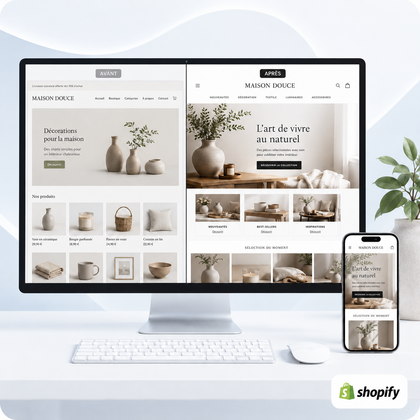



How to create a compelling Shopify store with few products?
A small range is not a fault. It can even make the choice easier, make the message clearer and concentrate the budget on truly successful files.
The method consists of assuming selection: choose only products ready to sell, group them into a few useful collections, use a consistent listing template, and build the welcome around your promise rather than volume.

Why a small catalog can be an advantage
The visitor does not judge a store by the number of references available. Above all, he checks whether he understands the offer, whether he finds a suitable product and whether he can buy with confidence.
A simpler choice
Fewer products allow you to quickly compare uses, formats or range levels without causing excessive hesitation.
More complete sheets
The available time can be spent on photos, benefits, features, frequently asked questions and delivery information.
Clearer communication
The homepage can carry a central promise and highlight each product without dispersing attention.
A small catalog only seems poor when presented as a large incomplete catalog. Avoid deep menus, empty collections, and sections that await future products.
The seven steps to building the store
Define a specific promise
Explain who the range is for, what need it covers and why your selection deserves attention. This promise guides the welcome and the sheets.
Select ready products
Keep references with reliable prices, margins, stocks, photos and characteristics. Do not publish an incomplete product just to fill the catalog.
Limit collections
Create a collection only if it really helps the visitor choose: use, universe, audience, format or level of range.
Build a product model
Keep the same order for promise, benefits, features, variants, delivery and reinsurance items.
Create an editorial welcome
Present the brand, the problem addressed, the flagship products, the differences, the method, the guarantees available and the answers to objections.
Prepare trusted pages
About, contact, delivery, returns, FAQs and policies must be accessible. They compensate for the lack of notoriety of a young store.
Test then enrich
Control mobile, links, variants, cart and payment. Then add products based on observed requests and data.
The right order of priority
- Reliable offer and content
- Complete product sheets
- Short navigation
- Reinsurance and mobile
- Progressive enrichment
To determine how many references to post, also see the guide How many products do you need to launch a Shopify store?
How to structure pages with few products
| Area | What to display | What to avoid |
|---|---|---|
| Menu | Home, shop or useful collections, About, contact | Numerous submenus and almost empty categories |
| Homepage | Promise, flagships, benefits, history, reinsurance and FAQ | Repeat the same product grid several times |
| Collection | Explicit title, short introduction and actually related products | A collection by product or variant |
| Product sheet | Use, benefits, details, variations, delivery and useful answers | A vague or identical description between references |
| Basket | Readable summary and reassuring information available | Forced additional sales unrelated to purchase |
Three examples of small, well-constructed catalogs
Single-product brand
A main product, several formats or batches and a page that explains the problem, usage, differences, delivery and objections.
Routine of six products
A range organized by stage: discover, use, complete. The welcome presents the routine and each sheet specifies the role of the product.
Handcrafted collection of ten pieces
A few simple categories, consistent visuals, and a common manufacturing story. New parts are added after launch.
Common principle: each reference justifies its presence. The store does not try to imitate a large distributor, but values an expert and understandable selection.
What SiteQuiVend offer for a small catalog?
Two situations must be distinguished: create a new complete store or improve the records of an already built store.
- 5 pages or key templates
- Up to 10 integrated products
- Up to 3 collections
- Responsive design
- Basic Shopify setup
- Harmonized structure
- Basic SEO
- Integration into the existing model
- Mobile verification
- Schedule confirmed after audit
Transparent limits: the €150 pack optimizes existing listings in a Shopify template already in place. Full writing from scratch, shoots, advanced edits, a new product template, Liquid development and licenses are offered separately.
If you are hesitating between autonomy and support, compare the two approaches in the guide Create your Shopify store yourself or hire a professional?
Checklist of a small store ready to sell
- The target and the promise are contained in a clear sentence.
- Each product has a different role in the range.
- Prices, margins, stocks and variants have been verified.
- The images are consistent and sharp enough.
- The sheets explain the benefits and characteristics available.
- The menu remains short and does not contain any empty categories.
- The reception does not repeat the same products unnecessarily.
- The About, contact, delivery and returns pages are accessible.
- Buy buttons are readable on phone.
- Cart, payment and emails have been tested.
- Basic metadata and alternative texts are provided.
- Upcoming products are planned without delaying launch.
For broader control, also use the list of 25 Essential Items of a Professional Shopify Store.
Shopify Small Catalog Store FAQs
Can you create a Shopify store with just one product?
Yes. A single-product store can be credible if the page clearly presents the offer, uses, benefits, variants, delivery and responses to objections.
How many collections do you need with ten products?
One to three collections are usually enough. Each collection should facilitate a real choice, not serve to artificially give the impression of a large catalog.
How to prevent the home page from appearing empty?
Add useful content around the range: promise, benefits, history, method, advice, reassurance and FAQ. Do not repeat several identical grids.
Should I create a sheet by color or size?
Not necessarily. When the product remains the same, colors or sizes can be managed as variations on a single, more complete sheet.
Should we wait until we have more products to launch the store?
No. It is best to publish a consistent, ready-to-sell selection and then add the following references based on stock, demands and observed results.
Which SiteQuiVend formula is suitable for up to ten products?
The Essential Creation formula is designed for 5 pages or key models, up to 10 products and 3 collections, from €990, with an indicative deadline of 5 to 7 working days.
Does the pack of ten cards at €150 create a new store?
No. It optimizes ten existing listings in a Shopify template already in place. The creation of a new store or a new product model corresponds to another service.
Can a small catalog be well referenced on Google?
Yes, but volume alone does not determine SEO. The quality of the files, the structure, the useful content, the technique and the authority of the site count more.
